How to play Bao
Bao is a two-player mancala game from East Africa, played on a board of four rows of eight pits. You sow seeds around your own two rows and capture from your opponent's front row, then sow the captured seeds back into play. You win by emptying your opponent's front row or leaving them with no move.
Step by step
Know your rows
Each player owns the two rows nearest them. The inner row, facing your opponent, is your front row.
Set out the seeds
In the learner's game, put 2 seeds in every pit. The full game starts differently, with most seeds held in hand.
Sow round your side
Pick up the seeds from one of your pits with at least 2 seeds. Sow them one by one, clockwise or anticlockwise, around your own 16 pits.
Capture from the front
If your last seed lands in an occupied pit in your front row, and the pit facing it has seeds, you capture them.
Sow your captures
Put the captured seeds back in at one end of your front row and sow them along it.
Keep going
If your last seed lands in an occupied pit and you cannot capture, pick up that pit and keep sowing. Your turn ends when a seed lands in an empty pit.
Win the game
You win when your opponent's front row is empty, or when they have no legal move.
The full rules
What you need
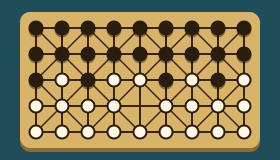
A Bao board has four rows of eight pits, 32 pits in all. You also need 64 seeds or stones. Each player owns the two rows nearest to them:
- the front row (the inner row, facing your opponent), and
- the back row (the outer row, nearest you).
In each front row, near the middle, there is one larger square pit called the nyumba, or house.
This guide explains the simpler learner’s game, Bao la Kujifunza, which is the best way to start. The full game, Bao la Kiswahili, is covered briefly at the end.
Setting up
For the learner’s game, place 2 seeds in every pit on the board. Each player starts with 32 seeds across their 16 pits.
Playing a turn
- Choose one of your pits that holds at least 2 seeds.
- Pick up all its seeds.
- Sow them one by one into the following pits, going either clockwise or anticlockwise around your own two rows.
Your seeds always stay on your side. You sow round your 16 pits like a loop: along the front row, round the end, along the back row and back again.
Capturing
After sowing, look at where your last seed fell.
If it landed in a pit in your front row that already had seeds in it, and the pit directly opposite in your opponent’s front row also has seeds, you capture. Take all the seeds from your opponent’s pit.
You then sow the captured seeds into your own front row, starting from one of its end pits (each end is called a kichwa) and working inwards:
- If the capture was made in one of the two pits at either end of your front row, the seeds start from that end.
- If it was made in one of the four middle pits, you choose which end to start from.
- If you capture again later in the same turn, the captured seeds start from the end that keeps you sowing in the same direction as before.
The first captured seed goes into the end pit itself. Then the sowing carries on as usual: if the last of those seeds lands in another occupied front-row pit facing an occupied pit, you capture again. A single turn can include several captures.
A capture must be made if one is possible: if any of your moves would capture with its first sowing, you must play one of those moves.
A turn whose first sowing does not capture is a quiet turn. In a quiet turn there are no captures at all, even if a later sowing ends in front of your opponent’s seeds; you simply keep relay sowing.
Continuing a sowing
If your last seed lands in an occupied pit but no capture is possible, pick up all the seeds in that pit and carry on sowing in the same direction. This is called relay sowing.
Your turn ends when your last seed falls into an empty pit.
Winning
You win the game if:
- your opponent’s front row is completely empty, or
- your opponent has no legal move, for example because none of their pits has 2 or more seeds.
The game ends as soon as a capture empties your opponent’s front row. A player whose own move leaves their own front row empty loses too.
Bao la Kiswahili, the full game
The full game is played in two stages. In the first stage, each player has only a few seeds on the board, including a stack in the house, and the rest are held in hand. On each turn, you place one seed from your hand into your front row, and you capture if the pit opposite holds seeds. Once both players have placed all their seeds, the game continues with sowing, as described above.
The full game adds detailed rules about the house, the direction of sowing after a capture, and which end of the front row captured seeds start from. These rules vary a little between regions and clubs, so it is worth agreeing them before you play.
Tips for beginners
- Protect your front row. Your front row is both your weapon and your weak spot. A front row with many seeds is strong, but each filled pit can also be captured.
- Count your sowings. Work out where your last seed will land, including any relay sowings, before you move.
- Look at the pit opposite. Before a move, check which of your front-row pits face full pits on the other side.
- Keep seeds in your back row. They are safe there and give you moves later.
- Start with the learner’s game. It teaches sowing and capturing without the extra rules of the full game.
Common questions
What is the difference between Bao la Kiswahili and Bao la Kujifunza?
Bao la Kiswahili is the full game, where players start with most of their seeds in hand and add them one at a time before the main game begins. Bao la Kujifunza, the learner's game, starts with seeds already on the board and skips that opening stage.
What is the nyumba in Bao?
The nyumba, or house, is a special square pit in each player's front row. In the full game it has extra rules and can hold a large store of seeds early on.
Is Bao a mancala game?
Yes. Bao is one of the four-row mancala games, and it is often thought of as one of the most complex in the family.
Can I capture from my opponent's back row?
No. Only the seeds in your opponent's front row can be captured.
Can I choose which way to sow?
Yes. You may usually sow clockwise or anticlockwise, but in many situations the rules fix the direction once a capture has been made.
Where it comes from
Bao is the Swahili word for board, and the game is widely played along the coast of East Africa, especially in Tanzania, Zanzibar and Kenya. It belongs to the large mancala family, and the four-row form is typical of East and Southern Africa. The full rules of Bao la Kiswahili are known for their depth, and the game is played in clubs and competitions in the region.