Free word games are one of the nicest ways to spend a few spare minutes: you can play them online in your web browser, there is nothing to install, and a good puzzle leaves you feeling a little sharper than before. This guide covers the main types of word puzzle you will find on word games websites, explains how each one works, and shares practical tips for getting better. All the free online word games mentioned here are on GamesBento, with no sign-up.
Why so many grown-ups love word games
Word games have been a fixture of newspapers, tea tables and car journeys for generations. Crosswords, anagrams and Hangman were around long before computers, and they moved online quite naturally. Today, word puzzle games online are among the most popular games there are.
People enjoy them for all sorts of reasons:
- They are calm. Most word puzzles have no timer, so you can think at your own speed.
- They feel productive. Many people find that a daily word puzzle helps them feel mentally alert, and it is satisfying to finish one.
- They suit short breaks. A single puzzle can take two minutes or twenty.
- They use what you already know. Your vocabulary, built up over a lifetime of reading and talking, is your biggest advantage, which is one reason word games for seniors are so popular.
- They are easy to share. It is fun to compare notes with a friend or family member on the day’s puzzle.
You may have read claims that word games “prevent” memory problems. The honest answer is that researchers are still working out what puzzles can and cannot do for the brain, and the evidence is mixed. What is clear is that a puzzle you enjoy is a pleasant, low-cost way to spend some time, and that is reason enough.
Word Scramble and unscramble puzzles
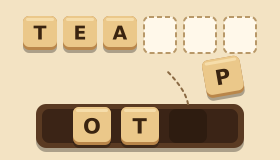
In a word scramble, you are given the letters of a word in a jumbled order and you have to put them back. For example, the letters T, E, A, H, R can be rearranged into HEART or EARTH. If you would like to play word scramble online, our Word Scramble gives you a short set of everyday words each day, and wrong guesses cost you nothing.
Tips for unscrambling words
- Look for common pairs. Letters such as TH, SH, CH, ER, ING and ED often belong together. Spot one and the rest of the word frequently falls into place.
- Try likely endings. If you see an S, try it at the end. If you see E and D, try -ED.
- Put the vowels between the consonants. Most English words alternate fairly evenly between consonants and vowels.
- Say it out loud. Hearing a half-made word is often what makes the answer pop into your head.
- Shuffle and look again. Rearranging the letters into a new order can break a mental block.
The Word Scramble guide has a few more ideas, along with the full rules.
Word Search: find the hidden words
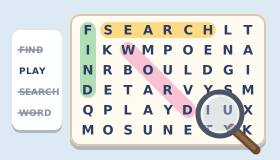
A word search is a grid of letters with a list of words hidden inside it. The words may run across, down or diagonally, and sometimes backwards. Your job is to find and mark each one. Puzzles often follow a theme, such as things you might find in a classroom, which gives you a helpful nudge. It is often the first word puzzle people try, and it is a lovely relaxing choice. You can play it on our Word Search page.
How to find words faster
- Hunt for the rare letters first. If a word contains a Q, Z, X, J or K, scan the grid for that letter. There are fewer of them, so you will find the right one sooner.
- Look for the first two letters together. Rather than searching for every C, look for C next to the second letter of the word.
- Sweep the grid in rows. Moving your eyes steadily along each row, then each column, is more reliable than darting about.
- Watch out for backwards words. Once you have found the easy ones, the stubborn remainder are often written in reverse or on a diagonal.
Word guessing games
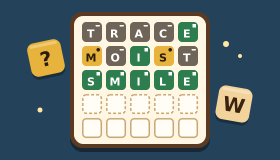
In a word guessing game, there is a hidden word, usually five letters long, and you have a set number of tries to find it. After each guess, the letters change colour to tell you which are in the word and in the right place, which are in the word but in the wrong place, and which do not appear at all. This style of game became hugely popular in recent years, and it is a clever puzzle game with words and logic in equal measure. Try it on our Word Guess page.
Good habits for word guessing
- Start with a word full of common letters. Words with several different vowels and common consonants, such as R, S, T, L and N, tell you the most.
- Do not reuse letters you know are out. It is tempting, but each guess is more useful when it tests new letters.
- Think about letter positions. A yellow letter tells you it is in the word but not in that spot, which narrows things down more than you might think.
- Remember double letters. Words like SHEEP or APPLE catch many people out.
Word Ladder puzzles
A word ladder asks you to turn one word into another by changing a single letter at a time, making a real word at every step. The classic example is turning COLD into WARM:
COLD → CORD → CARD → WARD → WARM
The idea is often credited to Lewis Carroll, the author of Alice’s Adventures in Wonderland, who published puzzles of this kind in the late 1870s. You can try one on our Word Ladder page.
Climbing the ladder
- Work out which letters must change. Compare the start and end words letter by letter. Those that already match can often stay put.
- Keep the vowels flexible. Changing a vowel usually opens up the most new words.
- Work backwards too. If you are stuck going forwards, think about which words are one step away from the finish.
Word Wheel puzzles
A word wheel shows a ring of letters around a central letter. You make as many words as you can from those letters, and every word must include the centre letter. On ours, the nine letters always spell one long word that uses every letter, which is the real prize. Have a go on our Word Wheel page.
Finding more words
- Start with short words. Three- and four-letter words warm you up and help you notice useful letter groups.
- Add endings. If you have found PLAN, try PLANS, PLANE or PLANT, if the letters allow.
- Look for the long word early. Seeing it often helps you find the shorter words hiding inside it.
Hangman: the classic guessing game
Hangman is the word game many of us played on scraps of paper at school. One player thinks of a word and draws a dash for each letter, and the other guesses letters one at a time. Wrong guesses build up a picture, and the guesser tries to find the word before it is complete.
Our Hangman uses a kinder picture than the traditional one: a flower that loses a petal with each wrong guess. We have written a full guide on how to play Hangman online, with rules, tips and variations.
How to get better at word games
Whichever puzzle you prefer, a few habits help across all of them.
Read widely and notice words
People who read a lot tend to do well at word games, because they have met more words in more forms. You do not need to study a dictionary. Simply noticing an unusual word in a book or newspaper and saying it to yourself is enough to help it stick.
Learn the common letter patterns
English has favourite combinations. Beginnings such as RE-, UN- and PRE-, endings such as -ING, -ED, -ER, -LY and -TION, and pairs such as TH, CH, SH and QU turn up again and again. Once you recognise them, scrambles and wheels become much easier.
Play a little, often
A short puzzle each day is more enjoyable, and probably more helpful, than a marathon once a month. Daily puzzles are good for this, because there is always a fresh one waiting.
Use hints without guilt
A hint is not a failure. It keeps the game fun and often teaches you a pattern you will spot on your own next time.
Take a break when you are stuck
It is remarkable how often a word appears in your mind the moment you stop staring at it. Put the kettle on and come back.
What to look for in a word games website
There are many word games websites offering free word puzzle games, and they vary a great deal. A good one should:
- Let you play straight away, without an account or email address.
- Use large, clear letters that are easy to read on a phone.
- Avoid timers by default, so you can think at your own pace.
- Save your progress on your device so you can come back later.
- Be honest that the games are free, with nothing to buy to keep playing.
Those are the standards we hold ourselves to on GamesBento, because they are what make online word puzzles for adults a pleasure rather than a chore. If you enjoy word games, you may also like our logic puzzles, such as Sudoku and Code Breaker, which reward the same patient, careful thinking. Our brain games page gathers word, logic and memory games in one place, and our games for seniors page picks out the easiest ones to start with. You can see everything we offer on the all games page.