How to play Dominoes
In dominoes you take turns laying tiles end to end, matching the number of spots where they touch. If you cannot play, you draw from the boneyard in the Draw game or pass in the Block game. The first to empty their hand wins the round and scores the spots left in the other hands.
Step by step
Shuffle the tiles
Turn all 28 tiles face down and mix them up. This pile is called the boneyard.
Take your hand
With 2 players, each takes 7 tiles. With 3 or 4 players, each takes 5 tiles.
Lay the first tile
The player with the highest double plays it first. If nobody has a double, the highest tile starts.
Match an open end
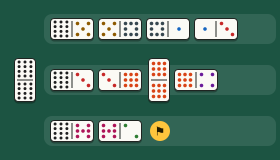
Take turns adding one tile to either end of the line. The touching ends must show the same number.
Draw or pass
If you cannot play, draw from the boneyard until you can (the Draw game), or simply pass (the Block game).
Go out to win
The first player to play their last tile wins the round. If nobody can play, the lowest hand wins.
Score the round
The winner scores the total spots left in the other players' hands. The first to 100 points wins the game.
The full rules
What you need
You need a standard set of 28 dominoes, called a double-6 set. Each tile is split into two ends, and each end has between 0 and 6 spots, called pips. A tile with the same number on both ends, such as 4 and 4, is called a double.
Dominoes can be played by 2, 3 or 4 people, each playing for themselves.
Setting up
Place all the tiles face down and shuffle them around the table. Each player then takes their hand:
- 2 players: 7 tiles each
- 3 or 4 players: 5 tiles each
Stand your tiles on their edges so only you can see them. The tiles left on the table are the boneyard.
The player holding the highest double goes first and lays it in the middle of the table. If nobody holds a double, the player with the highest-value tile starts with that tile. Every round starts this way. Play then moves clockwise (to the left).
Playing a turn
On your turn, add one tile to either open end of the line. The end you place against must match the number already there. For example, if the line ends in a 5, you can play any tile with a 5 on it, placing the 5 end against it.
Doubles are usually laid crossways, across the line, to make them easy to see. They still count as a single open end.
The line will bend around the table as it grows. That is fine: only the two open ends matter.
When you cannot play
This is where the two main versions differ.
- Draw dominoes: if you cannot play, take tiles from the boneyard one at a time until you find one you can play. Many people leave the last two tiles in the boneyard and pass once only those remain.
- Block dominoes: there is no drawing. If you cannot play, you knock on the table and pass.
Winning a round
The round ends when a player plays their last tile. They call “domino” and win the round.
Sometimes nobody can play and there is nothing left to draw. The game is then blocked. Everyone counts the pips in their hand, and the player with the lowest total wins the round. If two players tie for the lowest total, nobody wins that round.
Scoring
The winner of the round scores the total of all the pips left in the other players’ hands. In a blocked game, the winner usually scores the other players’ pips minus their own.
Keep playing rounds until one player reaches the target, usually 100 points. Some families play to 50 or 61 for a shorter game.
Common variants
- All Fives (Muggins): you score points during play whenever the open ends add up to a multiple of 5.
- Partnership dominoes: four players sit opposite their partners and score as a team, which is very popular in the Caribbean.
- Mexican Train: a game for larger groups using a double-12 set, with each player building their own train.
Tips for beginners
- Play your high tiles early. If someone goes out, the spots left in your hand count against you.
- Keep a variety of numbers in your hand so you have more chances to play.
- Watch which numbers your opponents pass on. If they could not match a 3, try to leave a 3 open.
- Count the tiles. There are only seven of each number, so you can often work out what is left.
- Hold on to a double until you can play it safely. Doubles are harder to get rid of because they match only one number.
Common questions
What is the difference between Draw dominoes and Block dominoes?
In Draw dominoes, if you cannot play you take tiles from the boneyard until you can. In Block dominoes there is no drawing: if you cannot play, you pass.
How many dominoes does each player get?
With a double-6 set, 2 players usually take 7 tiles each. With 3 or 4 players, each takes 5. Some groups give everyone 7 when 3 play.
What happens if the game is blocked?
If no one can play and nothing is left to draw, the game is blocked. Everyone counts the spots in their hand and the player with the fewest wins the round.
Do doubles go crossways?
Doubles are traditionally laid crossways so they stand out, but in the basic game they still count as one open end. Some games, such as Sevens or Fives, use doubles differently.
How many tiles are in a set of dominoes?
A standard double-6 set has 28 tiles. Larger sets exist: a double-9 set has 55 and a double-12 set has 91.
Where it comes from
Dominoes are thought to have come from China, where tiles of this kind were used for games many centuries ago. The European form of the game is believed to have appeared in Italy in the eighteenth century and spread from there. Today dominoes is widely played around the world, with strong traditions in the Caribbean, Latin America and many other places.