How to play FreeCell
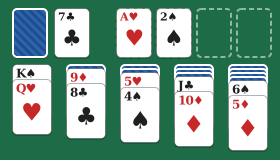
FreeCell is a solitaire card game where every card is dealt face up, so you can see everything from the start. You use four free cells to park cards while you build columns downwards in alternating colours. The aim is to move all 52 cards to the foundations, by suit from Ace to King.
Step by step
Deal eight columns
Deal all 52 cards face up into eight columns. Four columns get 7 cards and four get 6.
Know the free cells
There are four free cells at the top. Each can hold one card of any kind.
Build down in alternating colours
Move a card onto one that is one higher and the opposite colour, such as a black 8 onto a red 9.
Park cards in free cells
Move a card into an empty free cell to get it out of the way. Bring it back when it fits somewhere.
Use empty columns
Any card can go into an empty column, which makes empty columns very valuable.
Send cards home
Move Aces to the four foundations, then build each suit up from Ace to King.
Win the game
You win when all 52 cards are on the foundations.
The full rules
What you need
FreeCell uses one standard pack of 52 cards. Hearts and diamonds are red; clubs and spades are black.
Setting up
Shuffle and deal all 52 cards face up into eight columns. The first four columns have 7 cards each and the last four have 6 cards each.
At the top of the table there are two areas:
- Four free cells, usually on the left. Each one can hold a single card.
- Four foundations, usually on the right. These are where you build each suit from Ace to King.
Because every card is face up, you can see the whole game from the very start.
Moving cards in the columns
You can move the bottom card of any column onto the bottom card of another column if it is:
- one rank lower, and
- the opposite colour.
For example, a red 5 can go on a black 6. Aces are low.
The free cells
The free cells are your parking spaces. You can move the bottom card of any column into an empty free cell. You can move a card from a free cell back to a column whenever it fits, or straight to a foundation.
There are only four free cells, so use them wisely. When they are all full, your choices become very limited.
Empty columns
If you clear a column completely, any card, or any suitable run of cards, may be placed there. An empty column is even more useful than a free cell, because you can build a whole run in it.
Moving runs of cards
Strictly, you move one card at a time. But if a run of cards is in order (down in alternating colours), you can move it in steps by using free cells and empty columns. Most computer versions, including GamesBento, do this for you in one go, as long as you have enough space.
With no empty columns you can move one more card than the number of empty free cells. Each empty column doubles that. When you move a run into an empty column, that column does not count, so the limit is halved. For example, with two empty free cells and one empty column you can move 6 cards onto another column, or 3 cards into the empty column.
The foundations
When an Ace is free, move it to a foundation. Then build up in the same suit: 2, 3, 4 and so on, up to King. Once a card is on a foundation, it stays there.
Many computer versions move cards to the foundations for you when it is safe, and GamesBento does too. Aces and 2s always go up as soon as they are free. Any other card goes up by itself once both cards of the other colour that are one rank lower are already home. For example, the 5 of hearts goes up once the 4 of clubs and the 4 of spades are on their foundations, because no card left in play could then need the 5 of hearts to build on. You can still move any other card home yourself whenever it fits.
Winning
You win when all 52 cards are on the foundations. If you run out of moves, you can undo or restart the deal.
Deal numbers
Each deal has a number from 1 to 1,000,000, shown above the cards. Choose New deal to play a random deal or type in a number. The same number always gives the same cards, so you can replay a deal you enjoyed or challenge a friend to the same one.
Tips for beginners
- Look before you move. Every card is visible, so take a moment to plan.
- Free the Aces and 2s early. Find where the low cards are buried and work towards them.
- Keep free cells empty. Fill them only when it helps you make real progress, and empty them again quickly.
- Aim for an empty column. Emptying a column gives you the most freedom of all.
- Do not build long runs on top of low cards you will need soon.
- Use undo to learn. FreeCell rewards planning, and trying a different route is part of the fun.
Common questions
Can every FreeCell game be won?
Almost. In the classic set of numbered deals, only a tiny handful are known to be impossible. Nearly every deal can be solved with careful planning.
How many cards can I move at once?
Officially you move one card at a time, but most computer versions let you move a run of cards if you have enough empty free cells and columns to do it one card at a time.
What is the difference between FreeCell and Klondike?
In FreeCell all the cards are face up from the start and there is no stock pile. You use the free cells instead. That makes FreeCell a game of planning more than luck.
Can I take a card back from the foundations?
Some versions allow it, but on GamesBento cards on the foundations stay there. Cards only go up by themselves when no card left in play could still need them, so you never lose out.
What is a deal number?
Every deal on GamesBento has a number from 1 to 1,000,000. The same number always gives the same cards, so you can replay a deal or share it with a friend. Our numbers are our own and do not match the deals in other FreeCell programs.
Where it comes from
Games with free cells, or reserve spaces, have a long history among patience games. FreeCell in its modern form became widely known through home computers in the 1990s, which brought numbered deals that players could compare. It is now one of the most popular solitaire games in the world.