Lusona
Free online line puzzle · New puzzle every day · No sign-up
Lusona in a nutshell
Lusona puzzles are inspired by sona, the sand drawings of the Chokwe people. A line weaves diagonally between a grid of dots and bounces off the edge, but at the start it is broken into several separate loops. Tap the gaps between dots to place small mirrors that the line bounces off, until it becomes one unbroken line using exactly the number of mirrors asked for.
- Look at the drawing. The line already weaves diagonally between the dots and bounces off the edge. Each separate line has its own colour and its own dash pattern, and the counter says how many there are.
- Read the goal. Below the title you see how many mirrors of your own you must use, for example "Your mirrors: 0 of 3". The puzzle is solved when the drawing is one single line and you have used exactly that many.
- Tap a gap to place a mirror. Tap the space between two neighbouring dots. One tap places a horizontal mirror, a second tap turns it vertical, a third tap clears the gap. The line bounces off a mirror instead of crossing there.
- Join lines where they cross. Where two different lines cross, any mirror joins them into one. Look for a spot where two colours meet.
At a glance
- Players
- 1 player a calm drawing puzzle
- Length
- 2 to 10 minutes per drawing
- Equipment
- A grid of dots and one finger
- Learn it in
- 2 minutes harder patterns take thought
Lusona questions
What is a lusona?
A lusona (plural sona) is a drawing traced in the sand around a grid of dots, traditionally by the Chokwe people of north-eastern Angola and neighbouring regions. Accounts describe storytellers drawing them while telling a story, a proverb or a riddle.
Is this a traditional game?
No. It is a puzzle inspired by sona. The diagonal, bouncing line follows the way many sona are drawn, and the mirrors come from a way mathematicians describe these drawings. The patterns in the game are our own designs.
Why does a square grid need more than one line?
Without mirrors, a grid that is 3 dots by 3, or 4 by 4, always breaks into several separate lines. In general, a plain grid makes as many lines as the largest number that divides both its width and its height, so 6 by 4 makes two lines and 5 by 3 makes one.
What does the Hint button do?
It points to one gap and explains why, for example that two lines cross there or that a mirror is splitting the line. Press Hint again and it makes that change for you.
Can a puzzle have more than one answer?
Often, yes. Any arrangement that makes one unbroken line with the right number of mirrors counts as solved.
More free African games
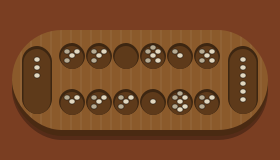 OwareSow seeds around the board and capture to win. Also played as Ayo and Awalé.
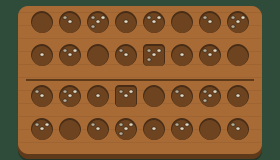 BaoFour rows of pits; the great strategy game of East Africa.
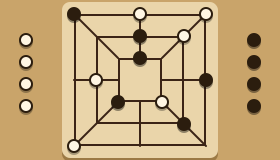 MorabarabaLine up three cows to capture, from Southern Africa.
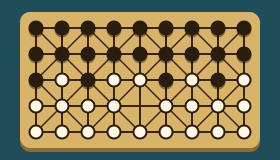 FanoronaCapture by approach and withdrawal, from Madagascar.
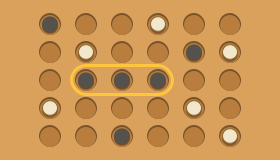 DaraMake rows of three in the sand, from West Africa.
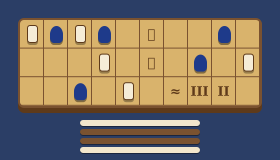 SenetRace across the board, from ancient Egypt.