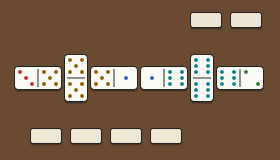
How to play Mexican Train
Mexican Train is a dominoes game where everyone builds a line of tiles out from a double in the centre. You add to your own train, to the shared Mexican Train, or to any train with a marker on it. Play your last tile to end the round, and after 13 rounds the lowest score wins.
Step by step
Set out the engine
The round starts with a double in the centre, called the engine. The first round uses the double 12, the next the double 11, and so on down to the double blank.
Take your tiles
With 2 to 4 players, everyone takes 15 tiles. The rest go face down in the boneyard, the pile you draw from.
Match the numbers
On your turn, play one tile so that its end matches the open end of a train. Your own train always starts from the engine.
Use the Mexican Train
There is one shared Mexican Train that anyone may start and play on, as long as the tile matches.
Draw if you are stuck
You must play if you can. If you cannot, draw one tile and play it if it fits. If it still does not fit, pass and a marker goes on your train.
Cover every double
When you play a double, you play again to cover it. Nobody may play anywhere else until that double has been covered.
Go out to end the round
The round ends when someone plays their last tile, or when the boneyard is empty and nobody can play.
Count the pips
Everyone scores the total of the spots left in their hand. After 13 rounds, the lowest total wins.
The full rules
What you need
Mexican Train is played with a double-12 dominoes set. That is 91 tiles, with every pairing of numbers from blank (0) to 12. Each tile has two ends, and each end shows a number of spots, called pips.
On this site you play against 1 to 3 friendly computer players, so there are 2 to 4 players in all. The computer deals, keeps the score and shows you which tiles you can play.
Setting up
A full game has 13 rounds. Each round starts with a different double in the centre, called the engine. Round one uses the double 12, round two the double 11, and so on, until the last round uses the double blank.
The tiles are shuffled face down and each player takes their hand:
- 2 to 4 players: 15 tiles each
- 5 or 6 players: 12 tiles each
- 7 or 8 players: 11 tiles each
The tiles left over form the boneyard. You draw from it when you are stuck.
Your train and the Mexican Train
Every player has a personal train. It starts from the engine and runs towards them. The first tile on your train must have one end that matches the engine. In round one, that means a tile with a 12 on it.
There is also one shared train, called the Mexican Train. It also starts from the engine. Anyone may start it, and once it is started, anyone may add to it.
Playing a turn
On your turn, play one tile onto the open end of a train you are allowed to use. The number on the touching end must match. You may play on:
- your own train,
- the Mexican Train,
- any other player’s train that has a marker on it.
You must play if you can. If you have no tile that fits, draw one tile from the boneyard. If that tile fits, you may play it straight away. If it still does not fit, you pass, and a marker is placed on your train.
A marker means your train is open to everyone. Other players may add their tiles to it. The marker comes off when you next play a tile on your own train.
Doubles
A double is a tile with the same number on both ends, such as the 7 and 7. When you play a double, it must be covered before anyone plays anywhere else. To cover it, a tile with that number is played against it.
The player who played the double plays again straight away to cover it. If they cannot, they draw one tile. If they still cannot cover it, a marker goes on their train and play moves on. The next players must cover the double first, before playing anywhere else. Anyone who cannot do so draws one tile, and passes with a marker if they still cannot.
There is one exception. If a double is your very last tile, playing it ends the round. It does not need to be covered.
Ending a round
A round ends in one of two ways:
- a player plays their last tile, or
- the boneyard is empty and nobody can play.
Scoring
At the end of each round, every player adds up the pips on the tiles still in their hand. That is their score for the round. The player who went out scores 0.
On this site, the double blank counts as 0 by default. Some people count it as 50, as a penalty for being caught with it. You can choose this in the settings.
After all 13 rounds, add up each player’s scores. The lowest total wins.
Common variants
Mexican Train has many house rules. Some groups allow you to play more than one tile on your first turn. Some let you play two doubles in one turn. Others use a double-9 set for a shorter game. The rules above are the ones this site uses, and they are among the most common.
Tips for beginners
- Plan your own train early. Look for a chain of tiles in your hand that link together from the engine.
- Keep tiles that fit your own train, and use the Mexican Train for awkward tiles.
- Get rid of high tiles first. If someone goes out, big tiles left in your hand cost you a lot.
- Be careful with doubles. Only play a double when you can cover it yourself, or when it will hold up a player who is about to go out.
- Watch for markers on other trains. They give you extra places to play.
Common questions
How many dominoes do you start with in Mexican Train?
With a double-12 set, each player takes 15 tiles for 2 to 4 players, 12 tiles for 5 or 6 players, and 11 tiles for 7 or 8 players. On this site you play with 2 to 4 players, so you get 15.
Can you play on the Mexican Train at any time?
Yes. The Mexican Train is shared, so on any turn you may start it or add to it, as long as your tile matches. The only exception is when a double is waiting to be covered.
What happens if nobody can cover a double?
The player who played the double tries first, drawing one tile if needed. If they still cannot cover it, their train gets a marker and the next players must cover the double before playing anywhere else.
Can you end the round on a double?
Yes. If a double is your last tile, playing it ends the round straight away. It does not need to be covered.
How much is the double blank worth?
On this site the double blank counts as 0 by default. Some families count it as 50 points, and you can choose that in the settings.
What is the marker for?
When you cannot play, a marker (often a small train) is placed on your train. While it is there, anyone may play on your train. It comes off as soon as you play on your own train again.
Where it comes from
Mexican Train is a modern dominoes game that is thought to have grown out of older train games played with large domino sets. It became popular in North America in the late twentieth century and is now widely played by families and clubs, especially with double-12 sets. House rules vary a good deal from table to table.