How to play Oware
Oware is a two-player mancala game played on a board of twelve pits. You take turns scooping up the seeds from one of your pits and sowing them one by one around the board. Capture seeds when your last seed makes a pit of two or three on your opponent's side, and win by collecting more than half of the 48 seeds.
Step by step
Fill the board
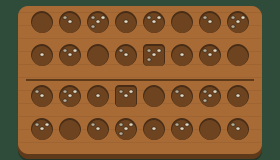
Put 4 seeds in each of the 12 pits. The row of 6 pits nearest you is yours.
Pick up a pit
On your turn, choose one of your pits that has seeds in it and pick up all of them.
Sow the seeds
Drop one seed into each pit in turn, going anticlockwise around the board. If you have 12 or more seeds, skip the pit you started from.
Capture twos and threes
If your last seed lands in your opponent's pit and makes it 2 or 3, you capture those seeds.
Keep capturing backwards
If the pit before it on their side also has 2 or 3, capture that too, and so on until the chain breaks.
Feed your opponent
If your opponent has no seeds, you must make a move that gives them some, if you can.
Reach 25 seeds
The first player to capture 25 or more seeds wins. At 24 each, the game is a draw.
The full rules
What you need
Oware is played on a board with two rows of six pits, one row for each player. You also need 48 seeds, beans or small stones. Some boards have a larger store at each end for captured seeds. If yours does not, simply keep your captures in a pile beside you.
You can even scoop twelve small hollows in the sand and play with pebbles.
Setting up
Sit facing each other with the board between you. The row of six pits nearest to you is your side. Place 4 seeds in every pit, so there are 48 on the board.
Decide who goes first. In later games, players often take turns to start.
Playing a turn
- Choose one of the pits on your side that has seeds in it.
- Pick up all the seeds in that pit.
- Sow them, which means dropping one seed into each pit in turn, moving anticlockwise. You start with the pit just after the one you emptied, and carry on round onto your opponent’s side if you need to.
If you have 12 or more seeds to sow, you will go all the way round the board. In that case, skip the pit you started from, so it stays empty.
Capturing
You capture by looking at where your last seed lands.
If your last seed lands in a pit on your opponent’s side, and that pit now holds exactly 2 or 3 seeds, you capture them. Take them off the board and keep them.
Then look at the pit just before it, still on your opponent’s side. If it also holds 2 or 3 seeds, capture those as well. Keep going backwards along their row until you reach a pit that does not have 2 or 3 seeds, or you run out of their pits.
You never capture from your own side.
Feeding your opponent
Oware has a strong rule of fairness. If your opponent’s row is empty, you must make a move that puts at least one seed onto their side, if you can.
Also, a move that would capture every seed on your opponent’s side is allowed, but under the Abapa rules it captures nothing. This stops a player from being wiped out in one turn.
Winning
The first player to capture 25 seeds or more wins, because that is more than half. If both players end with 24, the game is a draw.
If your opponent has no seeds and you cannot give them any, the game ends. You then usually take the seeds left on your side. If the last few seeds go round and round without anyone able to capture them, players can agree to end the game and each take the seeds on their own side.
Common variants
Mancala games are played in many places, and local rules differ. In Nigeria the game is called Ayo or Ayoayo, and some Yoruba versions use different sowing and capture rules from those above. Awalé, played in Côte d’Ivoire, is very close to Oware. Agree the rules before you start.
Tips for beginners
- Count before you sow. Count the seeds in a pit to see exactly where your last one will land.
- Watch your 1s and 2s. A pit on your side with 1 or 2 seeds is a target, because one more seed would make it 2 or 3.
- Build a big pit. Saving up seeds in one pit lets you lap the board later and make a long chain of captures.
- Keep moves in reserve. Try to keep several pits with seeds, so you are not forced into a bad move.
- Think about the end. Near the end of the game, try to keep seeds on your own side so they are not captured.
Common questions
Is Oware the same as Ayo and Awalé?
They are closely related members of the same family of mancala games. Oware is the Ghanaian name, Ayo the Yoruba name used in Nigeria, and Awalé the name used in Côte d'Ivoire. The rules can differ a little from place to place.
What does mancala mean?
Mancala is the name for the whole family of sowing games played with pits and seeds. Oware is one of the best-known mancala games.
Can I capture on my own side?
No. In Oware you only capture seeds from your opponent's row.
What happens if a move would capture all of my opponent's seeds?
Under the common Abapa rules, you may make the move but you do not capture anything, because that would leave your opponent unable to play.
How does an Oware game end?
It ends when one player has 25 seeds or more. It can also end when a player cannot be given any seeds, or when the same few seeds go round forever; the remaining seeds are then usually shared out or taken by the player whose side they are on.
What is a big house?
When a player builds up a large number of seeds in one pit, often 12 or more, it is sometimes called a house. Sowing it later can lap the whole board and set up a big capture.
Where it comes from
Oware belongs to the mancala family of games, which have been played across Africa for a very long time. It is especially associated with the Akan people of Ghana and is widely played across West Africa and the Caribbean. The rules described here are the Abapa rules, which are commonly used in tournaments.