How to play Senet
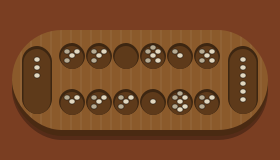
Senet is a two-player race game from ancient Egypt, played on a board of 30 squares. You throw sticks to see how far to move, swap places with lone enemy pieces, and try to steer clear of the water square. The first player to move all their pieces off the board wins.
Step by step
Set out the pieces
Place the 10 pieces on the first 10 squares, alternating colours. The path snakes along the three rows of ten.
Throw the sticks
Throw four flat sticks. Count how many land light side up: 1 to 4 moves that many squares, and none up moves 5.
Move a piece forward
Move any one of your pieces forward by your throw. A throw of 1, 4 or 5 earns another throw.
Swap with a lone piece
Land on a single enemy piece and you swap places with it. Two or more enemy pieces side by side are safe.
Mind the special squares
Square 26 must be landed on exactly. Square 27 is the water: a piece that lands there goes back to square 15.
Bear your pieces off
From the last squares, exact throws carry your pieces off the board. The first to remove all their pieces wins.
The full rules
A word about the rules
Senet was played in ancient Egypt, but no rulebook has survived. The rules on this page are a modern reconstruction, based on the work of historians who studied old boards and pictures. Different reconstructions exist, so you may see other rules elsewhere. All of them make a good game.
What you need
- A board of 30 squares, in 3 rows of 10.
- 10 pieces: 5 for each player, in two colours.
- 4 throwing sticks, flat on one side and rounded or dark on the other.
The path
Pieces travel along the board in a snake shape. They move along the top row from left to right, drop down and move along the middle row from right to left, then drop again and move along the bottom row from left to right. Square 1 is at the start of the top row and square 30 is at the end of the bottom row.
Setting up
Place the 10 pieces on squares 1 to 10, alternating the colours. The player who throws first takes the pieces on squares 1, 3, 5, 7 and 9; the other player, whose piece is furthest along on square 10, throws second.
Throwing the sticks
Throw all four sticks and count how many land with the flat (light) side up:
- 1 flat side up: move 1, and throw again
- 2 flat sides up: move 2
- 3 flat sides up: move 3
- 4 flat sides up: move 4, and throw again
- no flat sides up: move 5, and throw again
Playing a turn
Choose any one of your pieces and move it forward by the number you threw. You must move if you can.
- Empty square: simply move there.
- One enemy piece: you swap places. Your piece goes there, and theirs moves back to the square you came from.
- Two or more enemy pieces in a row: these protect each other. You cannot land on them, but you may jump over a pair.
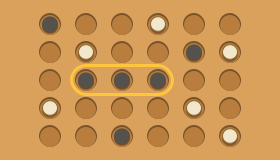
- Three enemy pieces in a row: these form a wall. You cannot pass them at all.
- Your own piece: you cannot land on it. Your own pieces never block you.
“In a row” means on squares next to each other along the path, so pieces on squares 10 and 11, or 20 and 21, count as side by side even though the path turns there. No square is safe on its own: a lone piece can be swapped anywhere, even on the special squares.
If you cannot make any move, your turn is over, even if you threw a 1, 4 or 5. In this version you never move backwards.
The special squares
- Square 15 is the house of rebirth. Pieces sent back return here.
- Square 26, often shown with a lucky sign, must be landed on exactly. Every piece must stop here before going further, so a throw that would carry a piece past it cannot be used for that piece.
- Square 27 is the water. The only way in is a throw of 1 from square 26. A piece that lands here is sent back to square 15, or to the nearest empty square before it. A throw of 1 still earns another throw.
- Squares 28, 29 and 30 need an exact throw to leave the board: a 3 from square 28, a 2 from 29 and a 1 from 30. From square 26, a throw of 5 also takes a piece straight off. A smaller throw moves a piece along these squares as usual (for example, a 1 from 28 moves it to 29).
Winning
Moving a piece off the end of the board is called bearing off. The first player to bear off all five pieces wins.
Common variants
Because Senet is a reconstruction, many versions exist. Some use 7 pieces each. Some allow pieces to move backwards when no forward move is possible. Some treat the squares near the end differently. Feel free to agree your own house rules.
Tips for beginners
- Pair up your pieces. Two pieces side by side cannot be attacked.
- Build a wall. Three in a row can hold back your opponent’s whole army.
- Do not leave pieces alone near the end. A lone piece on squares 26 to 30 is easy to swap back.
- Use your extra throws well. A throw of 1, 4 or 5 gives you another go, so plan two moves ahead.
- Steer clear of the water. When you can, avoid moves that could leave you landing on square 27.
Common questions
Do we know the real rules of Senet?
No. No rulebook survives from ancient Egypt. The rules played today are modern reconstructions, worked out by historians from boards, pictures and texts, and different versions exist.
What do the special squares mean?
Several squares near the end of the board are decorated on ancient boards. In modern rules, square 15 is a safe starting point for pieces sent back, square 26 is a lucky square that must be reached exactly, and square 27, the water, sends a piece back.
What can I use instead of throwing sticks?
Any four two-sided objects will do, such as lollipop sticks marked on one side, or coins. Some people use a die and treat a 6 as no move.
What if I cannot move any piece?
If none of your pieces can move by the number thrown, you lose that turn. In some reconstructions you must move a piece backwards instead.
How many pieces does each player have?
Most modern versions use 5 pieces each, though some use 7. Ancient boards have been found with varying numbers of pieces.
Where it comes from
Senet is one of the oldest known board games. Boards have been found in ancient Egyptian tombs, and pictures show people playing it, so it was clearly popular for a very long time. It is thought to have taken on a religious meaning, linked to the journey of the soul after death. Because no rules were written down, the rules played today are a modern reconstruction.