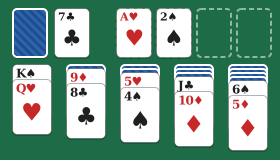
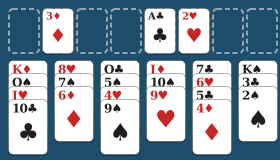
How to play Spider Solitaire
Spider Solitaire is a patience game played with two packs of cards in ten columns. You build cards downwards and gather each suit into a complete run from King down to Ace, which is then removed. Clear all eight runs to win.
Step by step
Deal ten columns
Deal 54 cards into ten columns: 6 cards in each of the first four, and 5 in each of the other six. Only the bottom cards are face up.
Build down in any suit
Move a card onto one that is one rank higher, such as a 7 onto an 8, whatever the suit.
Move runs of one suit
You can move a group of cards together only if they are all the same suit and in order.
Turn over hidden cards
When the face-up cards are cleared from a column, turn over the next card.
Deal from the stock
When you are stuck, deal one new card face up onto every column. Every column must have at least one card first.
Complete a suit
When you build a full run from King down to Ace in one suit, it is removed from the table.
Clear all eight runs
You win when all eight complete runs have been removed.
The full rules
What you need
Spider is played with 104 cards, which is two standard packs without jokers. The game can be played with one, two or four suits:
- One suit: all the cards are spades. This is the best way to learn.
- Two suits: spades and hearts.
- Four suits: all four suits, as in normal packs. This is the hardest.
Setting up
Shuffle the cards and deal ten columns:
- The first four columns get 6 cards each.
- The other six columns get 5 cards each.
That is 54 cards. In each column, only the bottom card is face up.
The remaining 50 cards form the stock. They will be dealt out later, ten at a time, in five deals.
Building in the columns
You can move the bottom card of a column onto another column if it is exactly one rank lower than the card it lands on. The suit does not matter. For example, any 6 can go on any 7. Kings are high and Aces are low.
When you move away the last face-up card from a column, turn over the card beneath it.
Moving runs
A run is a group of cards in order, such as 9, 8, 7. You can move a run together only if every card in it is the same suit. If a run is mixed, you can only move the cards from the bottom up to where the suit changes.
This is why it pays to build in the same suit whenever you can, even though you are allowed to mix suits.
Empty columns
When a column is empty, you can put any card or any same-suit run in it. Empty columns are very useful for sorting out mixed runs.
Dealing from the stock
When you have made all the moves you want, deal from the stock. One card is dealt face up onto the bottom of each of the ten columns. In the standard rules, you cannot deal while any column is empty. The only exception is near the end of a game: if fewer than ten cards are left on the table, so the columns cannot all be filled, you may deal anyway.
Completing a suit
When a column holds a complete run of one suit, from King down to Ace, it is removed from the table. Most computer versions do this automatically.
Winning
You win when all eight full runs have been built and removed. If the stock is empty and you cannot make any more useful moves, the game is lost.
Scoring
Computer versions often start you with 500 points, take away 1 point for every move, and add 100 points for every completed suit. You do not need to keep score to enjoy the game.
Tips for beginners
- Start with one suit. It teaches you the game without the frustration.
- Turn over hidden cards. Freeing face-down cards gives you more choices.
- Build in suit when you can. Same-suit runs can be moved; mixed runs get stuck.
- Empty a column, then use it. An empty column lets you untangle mixed runs.
- Make every move before dealing. A new deal covers every column, so tidy up first.
Common questions
What is the difference between one, two and four suit Spider?
The game always uses 104 cards. In one-suit Spider they are all spades, which is the easiest. Two-suit uses spades and hearts. Four-suit uses all four suits, which is much harder.
Can I put any card in an empty column?
Yes. Any single card, or any run of the same suit, can go into an empty column.
Why can I not deal from the stock?
In the standard rules, every column must have at least one card in it before you deal. Fill any empty columns first. If fewer than ten cards are left on the table, you may deal anyway.
Can every game of Spider be won?
Not every deal, but with one suit most games can be won. The four-suit game is a real challenge, even for experienced players.
Why is it called Spider?
It is often said that the name comes from the eight completed runs, like the eight legs of a spider.
Where it comes from
Spider is a long-established patience game for two packs of cards, and one of the best-known two-pack games. It became far more widely known when it was included on home computers around the turn of the millennium. It remains one of the most popular solitaire games played on computers and phones.