How to play Sudoku
Sudoku is a number puzzle played on a grid of 9 by 9 squares. You fill in the empty squares so that every row, every column and every 3 by 3 box contains the numbers 1 to 9 exactly once. No maths is needed, only careful logic.
Step by step
Look at the grid
The grid has 9 rows, 9 columns and 9 boxes of 3 by 3 squares. Some numbers are already filled in.
Learn the one rule
Each row, each column and each box must contain the numbers 1 to 9, once each.
Find an easy square
Look for a row, column or box that is nearly full. The missing number is easy to spot.
Scan for a number
Pick a number, such as 5, and see where it already appears. That rules out squares in the same rows, columns and boxes.
Use pencil marks
If you are unsure, write small notes of the numbers a square could hold.
Finish the grid
Keep going until every square is filled. A well-made Sudoku has only one solution.
The full rules
What you need
Sudoku is played on a square grid of 81 small squares, arranged in 9 rows and 9 columns. The grid is also divided into nine boxes, each 3 squares by 3 squares, usually marked with thicker lines.
Some squares already have numbers in them. These are the clues, and they cannot be changed.
The rule
There is only one rule. Fill every empty square with a number from 1 to 9 so that:
- each row contains 1 to 9, once each,
- each column contains 1 to 9, once each, and
- each 3 by 3 box contains 1 to 9, once each.
That means no number can ever repeat within a row, a column or a box.
Getting started
Look for nearly full areas
Find a row, column or box with only one or two empty squares. Work out which numbers are missing. If only one is missing, write it in.
Scan for one number at a time
Choose a number, for example 7. Look at each box in turn. For a box without a 7, look along the rows and columns that pass through it. If a 7 already appears in one of those rows or columns, the 7 cannot go in that part of the box. Often only one square is left, and that is where the 7 must go.
Check a single square
Pick an empty square. Look at its row, its column and its box, and list every number already used. If eight different numbers are used, the ninth must go in that square.
Pencil marks
When a square could hold more than one number, write the possibilities in small numbers in the corner. These notes are called pencil marks or candidates. As you fill in other squares, cross off candidates that are no longer possible. When a square has only one candidate left, you have found its answer.
Most computer versions have a notes mode to make this easy.
Winning
The puzzle is solved when all 81 squares are filled correctly. There is no score in the traditional game, only the satisfaction of finishing. Some versions time you, or show your mistakes.
Common variants
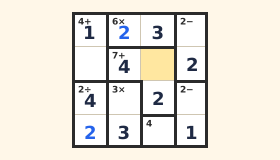
- Calcudoku (also called Mathdoku) adds sums inside outlined cages.
- Killer Sudoku combines Sudoku with cages that show a total.
- Mini Sudoku uses a 4 by 4 or 6 by 6 grid, which is ideal for learning.
- Jigsaw Sudoku replaces the square boxes with irregular shapes.
Tips for beginners
- Never guess. A good puzzle can always be solved by logic. If you must guess, a mistake can spoil the whole grid.
- Work on the easiest areas first. Each number you place gives you more clues.
- Go through 1 to 9 in order. Scanning for each number in turn is simple and very effective.
- Look for pairs. If two squares in a box can only hold 3 and 8, then no other square in that box can be 3 or 8.
- Take a break. If you are stuck, coming back later often helps you see what you missed.
Common questions
Do you need to be good at maths to play Sudoku?
Not at all. The numbers are only used as symbols. You could play with nine letters or colours instead; it is a puzzle of logic, not sums.
Can a Sudoku have more than one answer?
A properly made Sudoku has exactly one solution. If you find more than one, the puzzle was not made correctly, or a mistake has crept in.
What should I do when I am stuck?
Go through the numbers 1 to 9 one at a time and scan each box. Pencil marks also help you spot squares where only one number is possible.
What is the difference between easy and hard Sudoku?
Easy puzzles have more numbers filled in and can be solved with simple scanning. Harder ones need more advanced techniques that look at how possibilities interact.
Is there a new Sudoku every day?
Yes. GamesBento has a new daily puzzle every day in Easy, Medium and Hard, and everyone gets the same puzzle on the same date. Solve one each day to build a streak.
Where it comes from
Number-placement puzzles of this kind are thought to have been developed in the United States in the late 1970s. The puzzle was later popularised in Japan, where it was given the name Sudoku, roughly meaning single number. It became a worldwide craze in the mid-2000s, when newspapers began printing it daily, and it remains one of the most popular puzzles in the world.