Memory games are some of the simplest and most satisfying games there are. The best-known is the classic pairs game: lay the cards face down, turn over two at a time, and try to remember where everything is so you can find all the matches. You can play it free online on GamesBento as Memory Match, with large cards, three levels and no sign-up. This guide explains how it works, shares a few tips, and points you to other games that quietly ask your memory to help out, from Hangman to a hand of Gin Rummy.
The classic memory game: pairs, Concentration and Pelmanism
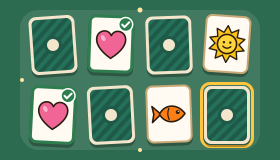
Most of us played some version of this as children, perhaps with a special set of picture cards or an ordinary pack spread out on the carpet. It goes by lots of names. In Britain it is often called Pairs or Pelmanism; elsewhere it is known as Concentration, Match Up or simply the memory game.
The rules could hardly be simpler:
- All the cards start face down in a grid.
- Turn over any two cards.
- If they match, they stay face up (or are taken away).
- If they do not match, they are turned back over, and you try to remember what you saw.
- Keep going until every pair has been found.
What makes it fun is that every card you turn over is useful information, even when it is not a match. Early in the game you are mostly exploring. Later, you start to think, “I have seen another one of those, top left, I am sure of it,” and that moment of being right is a small pleasure.
Playing Memory Match online
Our Memory Match is the classic pairs game, made comfortable to play on a tablet, phone or computer.
- Large, clear cards that are easy to see and tell apart.
- Easy, medium and hard levels, so you can start with a handful of pairs and add more when you feel ready.
- A daily puzzle, the same for everyone, if you enjoy a little routine.
- No timer pushing you along. Take as long as you like over each turn.
- No account and no download. It opens in your web browser and saves as you go.
The How to play Memory Match guide explains the rules in plain steps and has a few more tips.
Tips for finding pairs
There are no tricks to memory games, but a few habits make them easier and more enjoyable.
- Work in order. Rather than turning over cards at random, go along a row. It is much easier to remember “third along on the top row” than a scattered position.
- Say it in your head. Naming what you see, such as “red boat, corner”, gives your memory a hook to hang it on.
- Use what you know first. When you turn over a card and remember where its partner is, go straight there before exploring anything new.
- Start small. If the hard level feels like a muddle, there is no shame in dropping back to easy. The fun is in remembering, not in struggling.
Why people enjoy memory games
We are careful not to make promises about what games do for your brain. Memory games will not stop you losing your keys, and nobody can honestly promise they will change your memory over time. What they do offer is a pleasant workout for your memory and your concentration, a clear goal, and a satisfying finish.
Many people also like them because:
- They are quick. An easy game takes only a few minutes.
- They need no special knowledge. No spelling, no sums, no rules to look up.
- They suit all ages. Grandparents and grandchildren can play on equal terms, and older players often do very well.
- They are calm. Without a timer there is no pressure, just you and the cards.
Other games that use your memory
The pairs game is the obvious memory game, but plenty of others quietly ask you to remember things as you play. If you enjoy Memory Match, you might like these too.
Hangman
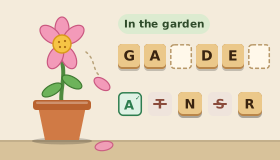
In Hangman you guess a hidden word one letter at a time. Part of the skill is keeping track of which letters you have already tried and which patterns you have ruled out. Our version is a gentle one: a flower loses a petal for each wrong guess, and themed clues give you a head start.
Code Breaker
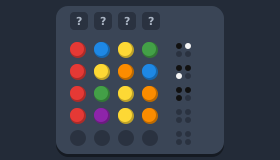
Code Breaker asks you to find a hidden colour code using the clues from each guess. The clues stay on the screen, but the real work is holding several possibilities in your head at once and remembering what each earlier guess told you. It is one of the best concentration games on the site.
Word Wheel
In Word Wheel you make as many words as you can from nine letters, always using the centre one. Your memory comes in twice: searching your vocabulary for words that fit, and remembering which ones you have already found.
Word Guess and Word Ladder
Word Guess gives you six tries to find a five-letter word, and you need to keep in mind which letters are in, which are out and which are in the wrong place. Word Ladder asks you to change one letter at a time to reach a goal word, which means holding the target in mind as you go.
Card games: remembering what has been played
Card players have always used their memory, and some of the most enjoyable card games reward it.
- Gin Rummy: keeping track of what your opponent picks up from the discard pile tells you what they are collecting, so you can avoid handing them the card they need.
- Cribbage: during the play, remembering which cards have gone helps you guess what is still to come and plan your next card.
- Hearts: many players try to remember which hearts have been played, and whether the Queen of Spades is still out there.
None of this is required. You can enjoy all three games simply by playing your own hand. But if you like a little extra challenge, try paying attention to the cards as they go by.
Mind games and puzzles
If you enjoy games that make you think, the logic puzzles are a natural next step. Sudoku and Nonograms are more about reasoning than memory, but they use the same steady concentration. You will find logic, word and memory games gathered together on the brain games page.
Memory games for seniors: making them comfortable
Memory games are a popular choice for older adults, partly because they are so easy to understand. A few small things can make them more comfortable.
- Play on a tablet. Tapping a card is easier than using a mouse, and a tablet sits nicely on a table or lap.
- Use full screen. The full screen button gives the cards as much room as possible, and turning a tablet sideways often helps too.
- Pick light or dark. The theme button at the top of the page switches between light and dark colours, so you can choose whichever is easier on your eyes.
- Keep sessions short. A couple of easy games is plenty. Stop while it is still fun.
If you are choosing games for a parent or grandparent, our guide to the best free online games for seniors has more ideas, and the games for seniors page brings our most comfortable games together in one place.
Playing memory games together
The pairs game was made for sharing. Pass the tablet back and forth: each person turns over two cards, and if you find a match, you score a point and have another go. Keep count on a scrap of paper, and whoever has the most pairs at the end wins. It works just as well with a grandchild of five as with a friend of ninety, and everyone gets to benefit from each other’s turns, which keeps the whole table involved.
You can play the old-fashioned way too. Take two of each card from an ordinary pack, say all the Aces, Kings and Queens, shuffle them and lay them face down on a table. Twelve cards is a good start; the whole pack makes a long and lively game.
Where to start
If you would like to give memory games a try, here is a simple plan:
- Open Memory Match on the easy level and play a game or two.
- When that feels comfortable, try medium, or have a go at the daily puzzle.
- For a change, play Hangman or Word Wheel.
- If you like a challenge with company, try Gin Rummy and see how many of your opponent’s cards you can remember.
Every game is free, with no account and no download, and you can find the rules for all of them on the guides page. Enjoy the gentle satisfaction of finding that last pair.