Some of the best time you can spend with an older parent or grandparent is over a game. It gives you something to do with your hands, something to talk about that is not the weather or the doctor, and often a bit of friendly rivalry that brings out a side of them you have not seen for a while. This guide gathers ideas for games to play with elderly parents and grandparents: classic table games, playing together on a tablet or TV, games over a video call, and group games that work well in care homes. It also has some simple ways to adapt a game so everyone can join in comfortably.
Start with the games they already know
The easiest way in is almost always a game they played years ago. Familiar rules come back quickly, and there is real pleasure in being the person who knows how it is done. Ask what they used to play. You may be surprised: a mum who has not touched a pack of cards in twenty years might turn out to be a fearsome Cribbage player.
Dominoes
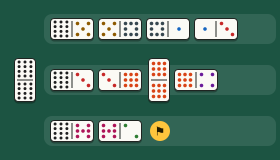
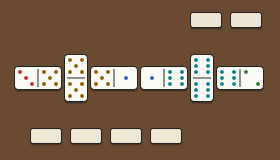
Dominoes are a wonderful choice. The tiles are chunky and easy to handle, the rules are simple, and a game fits nicely between cups of tea. Plain draw dominoes is the easiest; Mexican Train is a lively, sociable version where everyone builds their own line of tiles from a central hub, and it works well with three, four or more players.
If you would like a refresher on the rules before you visit, our guides to Dominoes and Mexican Train explain them in plain steps.
Card games
A pack of cards costs very little and offers hundreds of games. Some that work well across generations:
- Rummy or Gin Rummy: collecting sets and runs is easy to grasp and has just enough strategy to keep it interesting.
- Cribbage: a favourite of many older players, with its own special board and scoring.
- Whist or Hearts: trick-taking games that work well with four at the table.
- Snap or Old Maid: for when grandchildren are playing too.
Board games for seniors
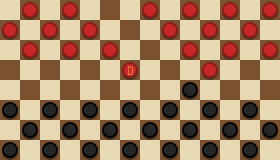
Classic board games like Checkers, known as draughts in Britain, are ideal for two people sitting across a table. Mancala games such as Oware are another lovely option: you sow seeds around a board of pits and try to capture more than your opponent. They are calm, tactile and easy to learn, and many families enjoy discovering them together.
Playing together on a tablet or TV
Not everyone has a games cupboard, and sometimes getting the pieces out feels like too much effort. A tablet can be a good alternative, because every piece is already there and nothing gets lost down the side of the sofa.
Taking turns on one tablet
Two-player games work well with a tablet on the table between you. Play a game of Checkers or Oware against the computer as a team, discussing each move together, or take it in turns to play a hand of Klondike Solitaire and see who gets further. Our games have big, clear pieces, undo for slips of the finger, and no timers in the puzzles, so nobody feels rushed.
Putting the game on the TV
If you have a smart TV or a way to show a tablet or laptop on the TV screen, a puzzle becomes a shared activity for the whole room. A Word Search or the daily Sudoku on a big screen invites everyone to call out what they spot. The full screen button on each game makes the most of the space.
Games over a video call
Living far apart does not have to mean no games. A few ideas that work well over the phone or a video call:
- The same daily puzzle. Many of our puzzles have a new one every day, the same for everyone. You can each play the daily Word Guess or Sudoku, then ring to compare how you got on.
- Hangman by video. One person chooses a word and draws the blanks on paper, holding it up to the camera; the other guesses letters. Our list of easy Hangman words for seniors has plenty of friendly themed words.
- Twenty questions or I-spy. Old favourites that need nothing at all.
- Card games on the screen. You can share your screen and play a hand of patience together, deciding each move between you.
Group games for seniors and care homes
If you are organising activities in a care home, a day centre or a family gathering, the best games are easy to join and just as easy to leave. Some that tend to go down well:
Hangman on a whiteboard
A whiteboard and a thick pen are all you need. Pick a theme, such as the garden or the seaside, write the blanks, and let the room call out letters. Many people prefer drawing a flower that loses a petal for each wrong guess, rather than the traditional gallows. Our online Hangman does exactly this, and it can go up on a big screen too.
Word games out loud
- Name five: name five flowers, five rivers or five songs from a particular year.
- Finish the saying: read the start of a well-known proverb and let the group finish it.
- Word chains: each person says a word that begins with the last letter of the one before.
These need no equipment and work well with a mix of abilities, because people can join in as much or as little as they like.
Dominoes and cards at tables
Small tables of three or four, each with a game of dominoes or rummy, can keep a room happily busy for an afternoon. Jumbo dominoes with large spots are easy to find and much easier on tired eyes.
Memory games
The classic pairs game, laying cards face down and turning them over two at a time, is easy to explain and fun in a group. You can play it with large picture cards at a table, or try our online Memory Match on a tablet or screen.
Adapting games so everyone can join in
A few simple changes can turn a frustrating game into an enjoyable one. You know your parent or grandparent best, so pick the ideas that suit them.
Bigger and clearer
- Large-print cards and jumbo dominoes are widely available and make a huge difference.
- A card holder helps anyone with stiff or shaky hands.
- Good light and a plain tablecloth make pieces stand out.
- On a tablet, try the light and dark themes, the full screen button and turning it sideways.
Shorter and gentler
- Play to a lower score, or agree on just a few rounds.
- Drop the timers. Let everyone take as long as they need.
- Simplify the rules if needed. Nobody minds if you skip a fiddly scoring rule.
- Stop while it is still fun. Two happy games are better than one long, tiring one.
Comfortable and sociable
- Sit comfortably, at a table of the right height, with everything in easy reach.
- Help without taking over. Offer a hint if asked, but let them make their own moves.
- Make it about the company. The chat often matters more than who wins.
When they want to play on their own
If a parent enjoys playing with you, they may like having games to play on their own between visits. Setting up a tablet with two or three favourite games on the home screen is a lovely thing to do. There is no account to create and nothing to buy, so there is no risk of surprise bills. Our guide to the best free online games for seniors explains how to set it up step by step, and the games for seniors page gathers the most comfortable games in one place.
A few final thoughts
The right game is the one that gets you both laughing. It might be a fierce game of dominoes, a gentle round of patience, or a muddled game of Hangman where nobody can spell the word. Do not worry about choosing perfectly. Bring something along, see how it goes, and let them teach you a thing or two. You can browse every game we have on the all games page.