Brain games are games that ask you to think rather than react: a Sudoku grid, a hidden word, a pair of cards you are sure you have seen before, or a board game where you plan a few moves ahead. You can play plenty of free brain games for adults online on GamesBento, in your web browser, with no download, no sign-up and no countdown clocks. This guide takes you through the main types, from logic puzzles to word, memory and strategy games, with advice on picking the right level, building a daily puzzle habit and keeping things calm.
You can also find our logic, word and memory games gathered together on the brain games page.
A quick word about “brain training”
You will see a lot of big promises made about brain games. We prefer to be straightforward. A good puzzle gives your mind a pleasant workout and a real sense of satisfaction when it comes out, and that is reason enough to play. We do not claim that any game will raise your IQ, sharpen your memory or change anything about your health, and we would be cautious of anyone who does. Play because you enjoy it.
Logic puzzles: brain teasers with one right answer
Logic puzzles are the classic brain teasers for adults. Each one has a single correct answer that you reach by reasoning step by step, never by guessing. That makes them very satisfying: when you finish, you know you got there fairly.
Number puzzles
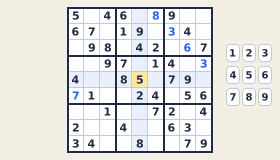
- Sudoku is the best known. Place the numbers 1 to 9 so that none repeats in any row, column or box. There is no arithmetic at all, just careful elimination. Pencil marks help you keep track of possibilities.
- Calcudoku adds simple sums to a Sudoku-style grid. Each outlined cage must make a target number, which gives you an extra way into the puzzle.
- Binary Puzzle fills a grid with only 0s and 1s, following three simple rules. It is quick to learn and surprisingly absorbing.
Picture and pattern puzzles
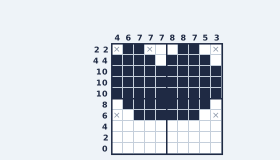
- Nonograms use number clues along each row and column to tell you which squares to fill. As you work, a hidden picture appears, which is a lovely reward.
- Minesweeper is a logic puzzle in disguise. The numbers tell you how many mines touch each square, and with practice you can clear a whole board without guessing.
- Lusona is a calm puzzle inspired by Angolan sand drawings, in which you place mirrors to make one unbroken line.
Deduction puzzles
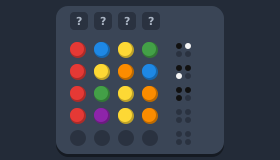
Code Breaker asks you to find a hidden colour code in ten guesses, using the clues after each try. It is a pure thinking game: every clue rules some possibilities in and others out, and the fun is in narrowing them down.
All of these are on the logic puzzles page.
Word games: mind puzzles with letters
Word games suit anyone who enjoys crosswords, reading or a good chat. They draw on your vocabulary and your sense of how words are built.
- Word Guess: find a hidden five-letter word in six tries, with each guess showing which letters are right.
- Word Wheel: make as many words as you can from nine letters, always using the centre one. Finding the one word that uses all nine is a small triumph.
- Word Ladder: turn one word into another by changing a single letter at a time.
- Word Scramble: put jumbled letters back in order to find an everyday word.
- Hangman: guess the word letter by letter, with a gentle flower in place of the usual drawing.
- Word Search: the calmest of the lot, finding hidden words in a themed grid.
Our article on free word games online goes into each in more detail.
Memory games
The classic memory game is the pairs game, sometimes called Concentration or Pelmanism. Cards are laid face down, you turn over two at a time, and you try to remember where each picture was so you can find every match.
Our Memory Match has large, clear cards, easy to hard levels and a daily puzzle. Many other games use your memory too, from keeping track of letters in Hangman to remembering which cards have gone in a game of Gin Rummy. Our guide to memory games for adults and seniors explores them all.
Strategy games: thinking a few moves ahead
Strategy games are mind games in the truest sense: you are trying to out-think an opponent. Ours let you play against a friendly computer player, with hints and undo if you want them.
- Checkers, or draughts, is the familiar jump-and-capture game, simple to learn and deeper than it looks.
- Oware is a West African mancala game where you sow seeds around a board and capture from your opponent’s side. Counting ahead to see where your last seed will land is the heart of it.
- Bao is the bigger, more complex mancala game of East Africa, for when you want a real challenge.
- Morabaraba is a game of forming lines of three and blocking your opponent from doing the same.
- FreeCell is a solitaire card game where nearly every deal can be won with careful planning, which makes it more puzzle than luck.
How to pick the right level
Most of our puzzles come in easy, medium and hard. Choosing well makes all the difference between a satisfying session and a frustrating one.
Start easier than you think
There is no shame in easy. It lets you learn how a puzzle works and get a feel for the techniques. Many experienced players still enjoy an easy Sudoku as a gentle warm-up.
Move up when it feels routine
When you are finishing easy puzzles without much thought, try medium. If medium feels like a struggle, drop back for a while. The best level is one where you have to think, but you usually get there in the end.
Use hints without guilt
Hints are there to keep you going, not to judge you. If you are stuck, a hint often shows you a technique you can use next time. Undo is there for slips of the finger and changes of mind.
Read the guide
Every game has a short How to play page with the rules and some tips. The Sudoku guide is a good example, and you can find them all on the guides page.
Building a daily puzzle habit
Many of our puzzles have a new daily puzzle, the same for everyone. A daily puzzle is a nice small habit: one Sudoku with your morning coffee, the daily Word Guess on the bus, a Nonogram before bed.
A few things help it stick:
- Pick a regular moment. Tie it to something you already do, like breakfast.
- Keep it short. One or two puzzles is plenty.
- Mix it up. A number puzzle one day and a word game the next keeps things fresh.
- Share it. If friends or family play the same daily puzzle, comparing notes is half the fun.
If you enjoy a bit of friendly competition, there is an optional weekly leaderboard. You choose a display name if you join; nobody has to.
Calm play: brain games that help you unwind
Not every brain game has to be a challenge. Some of the most pleasant moments come from a puzzle that keeps your hands and mind busy in a quiet way, the way a crossword or a bit of knitting does.
Because none of our puzzles has a timer, you can take them at whatever pace suits you. A few that many people find especially calm:
- Word Search, where there is no wrong move, just a gradual hunt.
- Nonograms, as the picture slowly takes shape.
- Klondike Solitaire, the familiar patience game.
- Tile Merge, sliding numbers together with no clock and undo whenever you want it.
Turning the sound off, choosing the dark theme in the evening and using full screen to hide everything else can all help make it a quiet few minutes. The relaxing games page has more ideas for calm play online.
Where to begin
If you are not sure where to start, try one game from each type and see which you enjoy:
- A logic puzzle: Sudoku on easy.
- A word game: Word Wheel.
- A memory game: Memory Match.
- A strategy game: Oware.
Everything is free, with no account and no download, and your progress saves as you go. You can browse the whole collection on the all games page.